Technology And Livelihood Education Curriculum Guide
Republic of the Philippines DEPARTMENT OF EDCUATION K to 12 BASIC EDUCATION CURRICULUM TECHNOLOGY AND LIVELIHOOD EDUCATION CURRICULUM GUIDE Exploratory Course on BEAUTY CARE (NAIL CARE) SERVICES K to 12 TECHNOLOGY AND LIVELIHOOD EDUCATION HOME ECONOMICS – BEAUTY CARE (NAIL CARE) SERVICES (Exploratory) Curriculum Guide for the Exploratory Course on Beauty Care (Nail Care) Services For you to get a complete picture of the complete TLE exploratory course on Beauty Care (Nail Care) Services, you are hereby provided with the Curriculum Guide on Beauty Care (Nail Care) Services. Content Standard Learning Competencies Performance Standard Project/ Activities Assessment Duration Performance test Written examination 3 hrs.
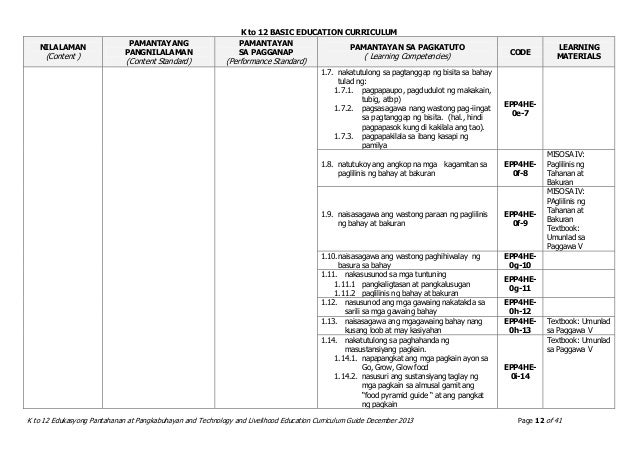
LESSON 1: USE OF NAIL CARE TOOLS AND EQUIPMENT Demonstrate understanding on: Nail care tools and equipment Uses of nail care tools and equipment 1. Tools and equipment are prepared based on salon procedure and policies. Tools and equipment are identified and checked according to task requirements. Tools and equipment are used according to task requirements. Safety procedure of using tools and equipment are observed.
Prepare the necessary tools and equipment for the specific nail care activity. Use nail care tools and equipment. Identify different tools and equipment according to task requirement.
Prepare the necessary tools, materials and equipment for the specific nail care services. Demonstrate the proper use of nail care tools and equipment. Written test Performance test 4 hrs. LESSON 2: MAINTAIN TOOLS AND EQUIPMENT Demonstrate understanding 1. Procedures for sterilization and sanitation of nail care tools and equipment 1. Audi mmi system troubleshooting. Procedures for sterilization and LO1.
Check condition of sanitation of nail care tools and nail care tools equipment are followed and.TWG on K to 12 Curriculum Guide – version January 31, 2012 Practical application on the proper handling and care of tools and equipment Performance test Written test 3 hrs. 2 K to 12 TECHNOLOGY AND LIVELIHOOD EDUCATION HOME ECONOMICS – BEAUTY CARE (NAIL CARE) SERVICES (Exploratory) Content Standard Performance Standard Learning Competencies equipment 2.
Classification of functional and non functional tools and equipment 3. Safekeeping and storage of tools and equipment 4.
PPE 1.Safekeeping of equipment and tools Project/ Activities Assessment Duration through group activities 2. Non- functional tools and equipment are segregated and labeled according to classification 3.
Tools and equipment are safely stored in accordance with salon requirements and local health regulations 4.Conditions of PPE are checked in accordance with manufacturer's instruction 1.Nail care tools and equipment are identified 2. Preventive maintenance technique and procedures 2.Appropriate cleaning procedure of nail care tools and equipment are applied. 3.OHS workplace regulations 3.Tools are cleaned according to standard procedures. LO2.Perform basic preventive and corrective maintenance Activity 1 Practical demonstration of proper way of keeping the workplace clean and safe to individual clients Written test Performance test 3 hrs. Student’s demonstration on sanitizing equipment and implements 4.Defective equipment and tools are inspected and replaced according to manufacturer’s specification.
Workplace is cleaned and kept in safe state in line with OHS regulations.TWG on K to 12 Curriculum Guide – version January 31, 2012 3 K to 12 TECHNOLOGY AND LIVELIHOOD EDUCATION HOME ECONOMICS – BEAUTY CARE (NAIL CARE) SERVICES (Exploratory) Content Standard Performance Standard Learning Competencies Project/ Activities Assessment Duration 4 hrs 1 Inventory of tools and equipment 2. Tool safekeeping/storage 1.Inventory of tools, instruments and equipment are conducted and recorded per salon practices.
2.Tools and equipment are stored safely in accordance with manufacturer’s specifications or salon procedure. LO3.Store nail care tools and equipment Demonstration of the proper way of storing tools and equipment Performance test Written tests. Group activity showing the inventory procedure in a simulated workplace. LESSON 3: PRACTICE OCCUPATIONAL HEALTH AND SAFETY PROCEDURES Demonstrate understanding: Hazards and Risks Common in Beauty salons 1. Work place hazards and risks are identified and clearly explained. Hazards and risks and its corresponding indicators are identified in the workplace. Effects of hazards are determined.
LO1.Identify hazards and risks. Venn Diagram Hazard Recognition Activity. Written examination Performance test 4hrs 6 hrs Common workplace hazards and their control measures Electricity Chemical hazard Slips, Trips, Falls Fire hazard Manual handling Biological hazard 1. Terms of maximum tolerable limits are identified based on threshold limit values (TLV). Effects of hazards are determined.
OHS issues and concerns are identified in accordance with workplace requirements 4. Sets of personal clothing.TWG on K to 12 Curriculum Guide – version January 31, 2012 LO2. Evaluate and control hazards and risks . Interview Film clips Written examination Performance Evaluation 4 K to 12 TECHNOLOGY AND LIVELIHOOD EDUCATION HOME ECONOMICS – BEAUTY CARE (NAIL CARE) SERVICES (Exploratory) Performance Standard Content Standard Ergonomics equipment are used hazards LESSON 4: PRACTICE BASIC NAIL DESIGNS Demonstrate understanding on: 1.
Nail structure and shapes are Structures of nail identified Nail shapes 2. Nails are trimmed and varied Nail disorders and shapes are applied; diseases Learning Competencies Project/ Activities Assessment Duration 3 hrs. Identify nail structure, shapes and nail diseases / disorders. Trimming nails applying the different basic nail shape Written test 3. Nail disorders and diseases are identified. Different nail designs are explained and Basic nail designs LO2.
Create basic nail designs. Demonstrated thru visuals. Different basic nail designs Performance test Written test 10 hrs Project making Basic nail designs in mock nails. Are demonstrated in mock nails “By three methods we may learn wisdom: First, by reflection, which is noblest; second, by imitation, which is easiest; and third by experience, which is the bitterest.” - Confucius.TWG on K to 12 Curriculum Guide – version January 31, 2012 5.
Technology And Livelihood Education Module
0 0 0 To highlight its worth in the, the Department of Education (DepEd) has formed a Technical Vocational unit in the Bureau of Secondary Education. For them, this unit needs strengthening as one of the three key strands that will prepare high school graduates by arming them with skills for employment. Contrary to what most people think, the K-12 program trains students in joining the workforce as early as 7th grade. The TLE or technological livelihood education subjects in junior high school or JHS follow the rules of the Technical Education and Skills Development Authority or TESDA. This will allow the students to earn a national certification (NC) required by the industry. Each TLE subject in Grades 7 and 8 is exploratory. This means each student has the chance to explore the following four main courses of TLE.
Design And Technology Curriculum
1) Agri-Fishery Arts 2) Home Economics 3) Information and Communications Technology (ICT) 4) Industrial Arts Students can choose a maximum of four TLE mini courses in Grade 7 and another four in Grade 8 that the school offers per locality’s needs and school assets. In Grades 7 and 8, the student does not yet earn a Certificate of Competency (COC).
The exploratory courses are a prelude to earning a COC in Grade 9 and an NC I/II in 10th grade. In Grade 9, the student chooses one course to focus on from among the exploratory courses he chose in 7th and 8th grades. Under this level, the student can earn a COC. In Grade 10, the student pursues the he chose in 9th grade. This allows him to get at least an NC Level I or II (NC I or II) based on the TLE course he chose. JHS graduates or incoming Grade 11 students will study core compulsory subjects and a required specialty. They can choose from the three main tracks such as Academic, Technical–Vocational-Livelihood (TVL), and Sports and Arts.
If the student picks the TVL track as specialty in senior high school or SHS, he/she will continue the TLE course he/she studied in 9th and 10th grades. This will allow him/her to earn NC II that he/she can use as credentials in applying for a job if he/she wants to work after SHS graduation. Yet if the student will study further, he/she can pursue the TVL track and earn a bachelor’s degree in a related field. For more details on K to 12, please feel free to search our web site.