Essentials Of Management Information Systems Study Guide

- Essentials Of Management Information System Study Guide Pdf
- Essentials Of Management Information System Study Guide
Samenvatting Business Modeling Essentials of Management Information Systems Chapter 1 1.1 The role of Information Systems in Business Today What’s new in management information systems? In the technology area are three interrelated changes: 1. The mobile digital platform composed of smartphones and tablet devices 2. The growth of online software as a service 3. The growth in “cloud computing”, where more and more business software runs over the Internet As management behavior changes, how work gets organized, coordinated, and measured also changes Due to social networking, collaboration tools, and wiki’s (decisions are made faster) o Even when separated by continents and time zones. What does globalization have to do with management information systems? EVERYTHING Six important business objectives: 1.
Operational excellence o Improve efficiency of operations achieve higher profitability 2. New Products, Services, and Business models o Business model: describes how a company produces, delivers, and sells a product or service to create wealth.
Essentials Of Management Information System Study Guide Pdf
Customer en supplier intimacy o Getting to know its customers and serves them well customers respond by returning and purchasing more raises revenues and profits. O Suppliers: the more a business engages its suppliers, the better the suppliers can provide vital inputs lowers costs. Improved decision making o Operating in fog bank: never having the right information at the right time to make an informed decision. Rely on forecasts, best guesses, luck 5. Competitive advantage o Doing things better than your competitors, helped with the information gathered by: operational excellence; new products, services and business models; customer intimacy; and improved decision making.
Survival o Necessities driven by industry-level changes 1.2 Perspectives on Information Systems and Information Technology Information technology (IT): consists of all the hardware and software that a firm needs to use in order to achieve its business objectives. Includes: computer machines, disk drives, mobile handheld devices, software (Windows/Linux operating systems), desktop productivity suite, and computer programs.
Information system (IS): can be defined technically as a set of interrelated components that collect (or retrieve), process, store, and distribute information to support decision making, coordinating, and control in an organization. May help managers and workers analyze problems, visualize complex subjects, and create new products. Contain information about: people, places en things within the organization or environment o Information: data that have been shaped into a form that is meaningful and useful to human beings. O Data: streams of raw facts representing events occurring in organizations or the physical environment before they have been organized and arranged into a form that people can understand and use.
Essentials Of Management Information System Study Guide
Input: captures or collects raw data from within the organization or from its external environment. Processing: converts this raw input into a meaningful form Output: transfers the processed information to the people who will use it or to the activities for which it will be used. Feedback: output that is returned to appropriate members of the organization to help them evaluate or correct the input stage.
Information systems literacy: behavioral as well as a technical approach to studying information systems. Computer literacy: focuses primarily on knowledge of information technology Management information systems (MIS): tries to achieve this broader information systems literacy, deals with behavioral issues as well as technical issues surrounding the development, use and impact of information systems used by managers and employees in the firm. Dimensions of information systems Organizations, people, and information technology Organizations Accomplishes and coordinates work through a structured hierarchy and through its business processes and has its own culture. Business processes: logically related tasks and behaviors for accomplishing work. O Developing a new product, fulfilling an order, hiring a new employee o Include formal rules that have been developed over a long time for accomplishing tasks. Culture: fundamental set of assumptions, values, and ways of doing things, that has been accepted by most of its members.

O Parts of an organizations culture can always be found embedded in its information systems. Different levels and specialties in an organization create different interests and points of view often conflict basis for organizational politics.
People: A business is only as good as the people who work there and run it. Technology is relatively inexpensive today, but people are very expensive, because people are the only ones capable of business problem solving and converting information technology into useful business solutions. Technology Information technology is one of many tools managers use to cope with change and complexity Computer hardware: physical equipment used for input, processing, and output activities in an information system.
Computers of various sizes and shapes; various input, output, and storage devices; and telecommunications devices that link computers together Computer software: consists of the detailed, preprogrammed instructions that control and coordinate the computer hardware components in an information system. Data management technology: consists of the software governing the organization of data on physical storage media. Networking and telecommunications technology: consisting of both physical devices and software, links the various pieces of hardware and transfers data from one physical location to another.

Network: links two or more computers to share data or resources (e.g. Printer) Internet is the world’s largest and most widely used network Intranets: internal corporate networks bases on Internet technology Extranets: private intranets extended to authorized users outside the organization World Wide Web: service provided by the Internet that uses universally accepted standards for storing, retrieving, formatting, and displaying information in a page format on the Internet. Information technology (IT) infrastructure: provides the foundation, or platform, on which the firm can build its specific information systems UPS invest heavily in information systems technology to make its business more efficient and customer oriented. 1.3 Understanding Information Systems: A Business Problem-Solving Approach Consider information systems and technologies as solutions to a variety of business challenges and problems.
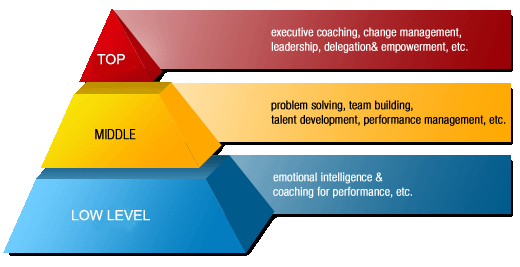
Samenvatting Business Modeling Essentials of Management Information Systems Chapter 2 2.1 Components of a Business Business: formal organization whose aim is to produce products or provide services for a profit. Strategic choice: decision of what to produce Determines your likely customers, the kinds of employees you will need, the production methods and facilities needed, the marketing themes, and many other choices. Senior management: makes long-range strategic decisions about products and services as well as ensures financial performance of the firm Needs summarized information Middle management: carries out the programs and plans of senior management Need more specific information Operational management: responsible for monitoring the daily activities of the business Need transaction-level information o Number of parts in inventory each day, or hours logged on by each employee Knowledge workers: engineers, scientists, architects design products or services and create new knowledge for the firm. Data workers: secretaries, clerks assist with administrative work at all levels of the firm Production or service workers: produce the product and deliver the service. 2.2 Types of Business Information Systems Transaction processing systems (TPS): system that keeps track of the elementary activities and transactions of the organization, such as sales, receipts, cash deposits, payroll, credit decisions and the flow of materials in a factory.
A computerized system that performs and records the daily routine transactions necessary to conduct business. Business intelligence: data and software tools for organizing, analyzing and providing acces to data to help managers and other enterprise users make more informed decisions. Addresses the decision-making needs of all levels of management Management information systems (MIS): designates a specific category of information system.